
1The Bioethanol is a product obtained by using composted organic matter in the fermentation alcohol, which is used three types of substances as raw materials are substances with high sucrose content that may be, sugar cane, sugar beet and sweet sorghum among others. Substances with high starch content, such as maize, cassava, potato. And substances with high cellulose content such as wood and agricultural waste.

process from starch is more complex than from the sucrose because the starch must be hydrolyzed prior to its division into large chains of glucose. For this plant is mixed with water and crushed with an enzyme or alternatively with an acid and heated from 120 to 150 ° C. Mass is then filtered in a process called scarification, and sent to fermentation reactors.
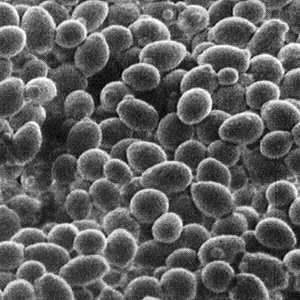
fermentation of sugars is carried out by microorganisms (yeast or bacteria) and produce large amounts of ethanol and CO2. It also produces other undesirable oxygenates such as methanol, acids and aldehydes. Typically fermentation of sugars requires about 48 hours. Reaction
sugar fermentation: Saccharomyces cerevisiae C6H1206
2 CH3CH2OH + 2CO2
The reaction is used as biocatalyst yeast Saccharomyces cerevisiae, this organism for each mol of hexose consumed produces two moles of ethanol and two moles of CO2.
2Entre bacteria, the most promising is Zymomonas mobilis, which converts 1 mol of hexose in 1 mol of EtOH, releasing only 1 mol of ATP, resulting in higher yields. This bacterium has a high tolerance for alcohol, but its range of fermentable substrates is also very close (glucose, fructose and sucrose; Moreover, their use on crops from sugar cane syrup leads to the formation of the polysaccharide levan, which increases the viscosity of the fermentation, and sorbitol, which reduces the conversion efficiency sucrose to EtOH.
bioethanol is also available through substances with high cellulose content that is wood and forest residues, waste paper recycling and paper industry, sugar cane bagasse, agricultural waste (leaves, twigs, grass, fruit, straw, etc. .) and municipal solid waste. The process aims to separate and subsequently hydrolyze cellulose to glucose is given a microbial fermentation process, metabolize various sugars. 3The
above processes occur by fermentation but can also occur via a petrochemical process in which there is direct hydration of ethylene in gas phase over a solid catalyst impregnated with phosphoric acid or sulfuric acid. The reaction of this process is as follows:

C2H4 + H2O H3PO4 or H2SO4 CH3CH2OH
The process of hydration reaction takes place at about 315 ° C of temperature and pressure Pa 5390k in a fixed bed reactor with a ratio of 0.6 mol water mol ethylene. The stability has silica gel at high temperatures makes it a very suitable substance as a catalyst carrier which is impregnated with any of the above acids.
This is to inform objectively about the environmental impact of ethanol production by biotechnological processes and a petrochemical.
1.LOPEZ SILVA, AB bioethanol manufacturing process (I). Chemical Engineering. Madrid Spain: June 2002, pp. 213-217. Vol 34 N ° 391.
2.http: / / www.scielo.org.ve/scielo.php?script=sci_arttext&pid=S0378-18442005001100005&lng=pt&nrm=iso&tlng=es
3.QUINTANA, Hospidio A. Manufacturing Process Bioethanol (III). Chemical Engineering. Madrid Spain: September 2002, pp. 158-176. Vol 34 N ° 393.


0 comments:
Post a Comment