Sunday, October 12, 2008

Free Wedding Program Wording Templates


SYSTEMS ENGINEERING


COURSE: INTRODUCTION TO ENGINEERING


TOPIC: THE RE-ENGINEERING


NAMES AND Pell
Eltom RUIZ VASQUEZ


PROFESSOR (A) LILY
SALAZAR


CYCLE:
I

SEMESTER 2008-II

House Warming Greetings Words

Definition and advantages and disadvantages

DEFINITION

The Reengineering According to Michael Hammer, reengineering is to start from scratch on a blank sheet, because it is believed that virtually everything we did before, as companies appear to be wrong considering the results.

reengineering, at first, a process that must be done from top to bottom, ie it must be initiated by the leader of an organization or country ("transformational leader"). If there is no political will to carry it out, if no decision and if resources are channeled to it, this will not succeed. Reengineering arises to rethink and redo the process of an organization based on two central arguments:

the case for action. _ Hammer defined as the "wedge" and that is the fundamental reason why we want or need to change. If you do not have a compelling reason, we will not make the change. It's like when the doctor tells the patient to have to change way of life or you will die within a month. The more radical and compelling is this argument "pro action", the more convinced we made the change.

The Argument Pro Vision . _ Hammer defined as the "magnet" and that is the vision that draws us, that is the goal or ideal that we are looking to change. The clearer vision of what we more easily we will move towards it and we will succeed. That vision, from chaos theory, is an "attractor" and a self-organizing drive, that align to all members of an organization toward the same purpose and the restoration of "order."

Behind the word reengineering, a new business model and a corresponding set of techniques that executives and managers will be employed to reinvent their companies. Under traditional thinking management of many of the employees performing tasks that had nothing to do with meeting the needs of customers. Many of these tasks are executed to meet internal demands of the organization of the company. In today's environment nothing is constant or predictable, or growth of the market or customer demand, and life cycle of products. How did the re-engineering? Many companies were forced, with the new features of the environment, to look different from the traditional ways to meet the great challenges of a highly competitive market. The traditional ways of dividing the work of structuring the organization by function, to seek specialization, etc. were not sufficient to make great leaps in a globalized environment, as studied and put into practice different ways to approach the job.The world is facing for the first time a relatively open setting, characterized by what some call the three C : Customers, Change and Competition. In fact, is no longer producing or selling the most important factor, but the customer.

The change is transformed from a sporadic phenomenon to something permanent.

The competition, open markets, passed a national or regional to a global. This environment demands high levels of quality, speedy service, great cost reductions and high levels of productividad.Es in this context emerges reengineering.

Customers gain a decisive position in the markets, demanding better services tailored to their own needs, forcing companies to review their concepts aimed at mass markets. The strong international market penetration by Japanese companies since the early eighties created new competitive conditions, in which the possibilities of choice by consumers is increasing.

change is pressured by technological advance, which offers new alternatives in the process, automation systems, improved quality and lower costs. Is this new scenario could only deal with traditional practices? The response of some companies was negative and, therefore, sought radical changes, which gave birth to what is now known as reengineering.

more specific definition

Customers Customers took command, and does not apply the concept of the customer, this customer now, because the mass market today is divided into segments, some as small as a single client. Customers are no longer satisfied with what they find, and now have multiple options to meet your needs. This is equally applicable in the customer-supplier relationship between the companies themselves, and claims are often expressed in: "Or what do you do as I want or do it myself." Customers have placed in an advantageous position, in part through access to more information. For companies that grew up with mass-market mentality, the reality is more difficult to accept about customers, in that each one counts. If a customer is lost today, no more appear to replace. Before competition was simple: the company could go to market with a product or service at the lowest price acceptable and make a sale. Now there is more competition and class very different. Globalization brings with it the fall of trade barriers and no company has its territory protected from foreign competition. American companies, Japan, Europe have experience in highly competitive markets and are very eager to win a portion of our market. Being big is no longer invulnerable, and all existing companies must have the wit to discover new companies on the market. New companies do not follow known rules and make new rules to run their businesses. The CambioEl change becomes a constant, the nature of change is also different. The speed of technological change also promotes innovation The life cycles of products have gone from years to months. Has decreased the time available to develop and introduce new products. Today, companies have to move faster, or soon will be completely paralyzed. The executives believe their companies are equipped with radar to detect the change effective, but most of them are not, what are the changes detected by them hope. The changes that can derail a company are what occurs outside their expectations.

ROLES OF THE RE-ENGINEERING To carry out the reengineering of processes have identified the following roles: Leader. Owner or responsible for the process. Reengineering team. Steering Committee. "Czar" of reengineering. The Leader is a senior executive who supports, empowers and motivates total reengineering effort. You must have sufficient authority to persuade people to accept radical changes involving reengineering. Without this process reengineering leader is in good intentions without ever culminating as expected.

should keep the ultimate goal of the process, you need the vision to reinvent the company under new competitive schemes, maintains communications to employees and managers to achieve the purposes and progress. Designate who will own processes and assigns responsibility for the progress in performance. Process Owner Area Manager responsible for a specific process and the corresponding engineering stress. In traditional companies do not think in terms of processes, functions departmentalize, which organizational boundaries are made to processes.

Processes must be identified as soon as possible, assign a leader and the owners of the processes. It is important that process owners have acceptance by peers with whom they will work, accept the processes of change that brings the re-engineering, and its main function is to monitor and encourage implementation of the reengineering. The office of the owners does not end when comprehensive re-engineering project, when it is committed to be focused on processes, each process is dealing with an owner who takes responsibility for its implementation.


ADVANTAGES AND DISADVANTAGES Advantages


effort is concentrated in areas of organizational and procedural point.
best accomplished in a short-term and visible results
If there is reduction of defective products, results in a reduction in costs as a result of lower consumption of raw materials.
increases productivity and leads the organization to competitiveness, which is critical for organizations today.
contributes to adaptation to technological processes.
Deletes repetitive processes.

Disadvantages

When the improvement is concentrated in a specific area of \u200b\u200bthe organization, they lose sight of the interdependence of all members of the company.
requires a change throughout the organization, as for success requires the participation of all members of the organization at all levels.
Given that managers in small and medium enterprises are Conservative Continuous Improvement is a long process.
have to make major investments.


CONCLUSION
Reengineering is the fundamental tool and the last change. She runs the business process of an organization. In its current state, helps set the business from old paradigms to a new service and information. In the future will continue to move the business. Reengineering using the continuous change to achieve competitive advantage. Opportunities for organizations to continue to grow if one considers that one way or another, most of these organizations will benefit businesses without much effort. However, businesses that earn the most will be those who can assimilate the latest technologies and take advantage of opportunities, so they prepare themselves for change.
reengineering VIDEO

What Are Lumps On Chest Cancer


http://www.monografias.com / jobs / reengineering / reingenieria.shtml
http://www.losrecursoshumanos.com/contenidos/81-reingenieria.html
http://www.kyna.com.mx/Que%20es%20Reingenieria.htm

Friday, October 3, 2008

Snowmobile Salvage John Deere

INTRODUCTION THE BIG QUESTION


Ethanol is an alcohol that can be produced by fermentation of sugar products. Specifically, the bioethanol production process is very similar to the fermentation of alcoholic beverages such as beer and wine among others.
Bioethanol is produced from cellulosic biomass materials, the term comprising all the organic material of plant origin, also including material from natural or artificial processing. Biomass can come from several types of crops:
crops and agricultural residues, forest residues, energy crops and other biomass sources.


The use of these resources previously unexplored in the fuel industry have emerged in response to environmental problems facing our planet and of course the depletion of nonrenewable resources as essential as oil. The implementation of the bioethanol will then allow the world to continue its quickened pace of life but from this, with benefits to the environment that reduce adverse change in the nature generated by the emission of polluting gases into the atmosphere, among others.


TABLE OF CONTENTS (click to enlarge)

Pantie Girdles On Woman


PLANTEAMIENDO THE TOPIC:

WHAT IS THE PROCESS FOR THE PRODUCTION OF INFLUENCE AS BIOETHANOL in minimizing environmental pollution?

GLOBAL KNOWLEDGE DEFICIT: WHAT IS
contribution of biofuels such as bioethanol TO MINIMIZE POLLUTION?

DEFICIT OF CRACKS:

WHAT FEATURES MAKE THE BIOETHANOL is more efficient than traditional fuels? RAW MATERIAL
WHAT IS USED FOR bioethanol production?
WHAT BRINGS ADVANTAGES AND PRODUCTION AND USE OF BIOETHANOL? NOW WHAT COUNTRIES
GO AHEAD IN bioethanol production?

WORDS: bioethanol, biofuel, ethanol.

QUALIFIERS: CONTRIBUTION, MINIMIZATION, FEATURES, ADVANTAGES, DISADVANTAGES, PROCESSING, AIR POLLUTION, PRODUCTION, USE, COUNTRY, VANGUARD, raw materials.

Flu Like Symptoms After Quiting Smoking


• synonymy was used:

Pollution: pollution, contamination, corruption, infection, inoculation.

Production: creation, development, manufacturing, fulfillment, procurement, product, industry, performance, productivity.

Use: wear, damage, withering, aging, lackluster, decadence, gnawing, rubbing, use, employment, dedication, occupation, enjoyment.

Countries: country, state, nation, kingdom, region, place, territory, place, region, republic.

Vanguard: front, vanguard, advanced

Front matter: substance, element, ingredient, component, body, being, mass.
Contribution: tax, fee, contribution, duty, excise, fee, charge, spills, subsidy, tax, tax, tax. Minimize

: belittle, diminish, dismiss, belittle.

Features: particularity, peculiarity, property, uniqueness.

Advantages: superiority, preeminence, priority, excellence, virtue, utility, attribute, benefit, merit, power, privilege, capability.

Disadvantages: obstruction, inconvenience, damage, injury, decline, grief.

process: start, progress, evolution, development, succession, series, stage, transform, process, technique, treatment, environment, trial, litigation, summary view, crowded, cause, prosecution.


• use search in English using google translator.
descriptors: bioethanol, bio-fuels, ethanol.
qualifiers: contribution, minimization, features, benefits, Disadvantages, PROCESS, Environmental Pollution, production, use, country, Vanguard, raw materials.

• use boolean operators.
decontamination
Bioethanol Bioethanol AND NOT ethanol
"bioethanol" OR Biofuel Bioethanol


• Library Literature from the University of Antioquia. Databases
• Antioch University • www.scirus.com


• Magazines • www.sciencedirect.com biotechnology

Free Music Sheet The Gift By David Nevue

SEARCH PROCESS RESOURCE OBJECTIVES AND RATIONALE


GOAL

WHO DO ATTEND THIS BLOG?

is aimed at those who in their field of study involving microorganisms and look interested in the processes that they can contribute such as industrial, chemical engineers, environmental, health, industrial, microbiologists, biologists, among others, so that they know or elaborate on the importance of biofuel kind to the environment, and spread in the critical mass to use these, as an energy alternative.
may also be of interest to those corporate monopolies that look directly linked to these processes for the production of bioethanol and wish to generate resources friendlier to the environment and lower costs.

WHAT?
Making people are familiar with the benefits brought by biofuels, and serve as a tool for partial reduction of environmental pollution and realize the use should have these. SPECIFIC OBJECTIVES


• Disclose to make clear the necessary use of ethanol as alternative fuel.
• Analyze the environmental problems generated by conventional fuels.
• Build mass awareness among the population about the use of such biofuels.
• Evidence that raw material makes possible the production bioethanol.
• Learn more microorganisms used in the production of bioethanol.

Baby Bernardelli .22s


• LOPEZ SILVA, AB bioethanol manufacturing process (I). Chemical Engineering. Madrid Spain: June 2002, pp. 213-217. Vol 34 N ° 391.
• SILVA LOPEZ, LOPEZ Facal AB, Javier. Feijoo Costa, G. Bioethanol production process (II). Chemical Engineering. Madrid Spain: July and August 2002, pp. 145 to 151. Vol 34 N ° 392.
• QUINTANA, Hospidio A. Bioethanol production process (III). Chemical Engineering. Madrid Spain: September 2002, pp. 158-176. Vol 34 N ° 393. • CALA HEDERIC
, David. Bioethanol Fuel: solution and business opportunity for the country. Colombia: Science and Technology. Bogota Colombia: April to June 2005, pp. 12 to 20. Vol 23 No. 2.
• COMPTROLLER GENERAL OF THE REPUBLIC. Organic fuels in Colombia. In: Bioethanol and Biodiesel [In Online] [accessed 24 September 2008]. Available at: 20biodiesel http://www.contraloriagen.gov.co:8081/internet/central_doc/Archivos/269/Bioetanol% 20and%,% 20the% 20combustibles% 20ecol% C3% B3gicos.doc.
• PALAFOX MONCADA, Ariadna. Environmental pollution. In: Monographs [Online] [accessed 25 September 2008]. Available at: http://www.monografias.com/trabajos34/contaminacion-ambiental/contaminacion-ambiental.shtml
• BALAT, Mustafa. Havva BALAT. OZ Cahide. Progress in bioethanol processing. In: Progress in Energy and combustion science. [Online] Vol 34, Issue 5, October 2008, pp. 551-573. [Accessed 25 September 2008]. Available at: http://www.sciencedirect.com/science?_ob=ArticleURL&_udi=B6V3W-4RPD795-1&_user=10&_coverDate=10% 2F31% 2F2008 & _alid = 796119588 & _rdoc = 8 & _fmt = high & _orig = search & _cdi = 5741 & _docanchor = & view = c & _CT = 266 & _acct = C000050221 & _VERSION = 1 & _urlVersion = 0 & _userid = 10 & md5 = bcae13cd587e922a5f74af387682b85e
• Author Reserved. Ethanol (fuel). In: wikipedia. [Online] [accessed 23 September 2008]. Available at: http://es.wikipedia.org/wiki/Etanol_ (fuel)
• CHOY, Gladys. Biofuels, recent developments and their impact trade balance. In Scirus. [Online] March 2008. [Accessed September 25, 2008]. Available at: http://ideas.repec.org/p/rbp/wpaper/2008-005.html

What's A Good Master's Gpa


RESOURCES
This project is performed by Maria Alejandra Garcia, Luis Alfredo Baquero, María Luisa Munera, Laury Paola Dix, students of Industrial and Environmental Microbiology at the University of Antioquia. And advised by Professors Catherine Street and Relief Ramirez of the program and university.
use was made of the literature of the central library (University of Antioquia), Internet Access, the database system of the library, academic google, and some searches were conducted in English therefore made use of pages as a translator of google, and bireme.br.
The blog paper the process is very important because through this you can learn to create and make use of some cyber tools properly. In which performs a selective and thorough search to be presented on the blog.

Justification:


Work carried out, apart from being a student obligation, is of great importance as industry, commerce and the general population, depend directly on fuel use. At home, in business, transportation, and large industries is a huge dependence on fuel. Seeing the concern that fossil fuels are depleted, and also pollute the environment came the need for alternative fuels. A part of that do not pollute the environment are much cheaper than oil. It is known that ordinary people are already aware of the existence of bioethanol, but we want to accomplish with this blog is to deepen about this, and see the great value and benefits that may occur to the population and the environment.

Illinois State Id Hologram

BIBLIOGRAPHY IS THE PROCESS OF BIOETHANOL?


1The Bioethanol is a product obtained by using composted organic matter in the fermentation alcohol, which is used three types of substances as raw materials are substances with high sucrose content that may be, sugar cane, sugar beet and sweet sorghum among others. Substances with high starch content, such as maize, cassava, potato. And substances with high cellulose content such as wood and agricultural waste.


process from starch is more complex than from the sucrose because the starch must be hydrolyzed prior to its division into large chains of glucose. For this plant is mixed with water and crushed with an enzyme or alternatively with an acid and heated from 120 to 150 ° C. Mass is then filtered in a process called scarification, and sent to fermentation reactors.
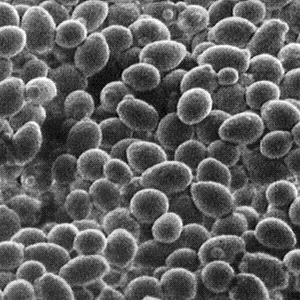
fermentation of sugars is carried out by microorganisms (yeast or bacteria) and produce large amounts of ethanol and CO2. It also produces other undesirable oxygenates such as methanol, acids and aldehydes. Typically fermentation of sugars requires about 48 hours. Reaction
sugar fermentation: Saccharomyces cerevisiae C6H1206
2 CH3CH2OH + 2CO2

The reaction is used as biocatalyst yeast Saccharomyces cerevisiae, this organism for each mol of hexose consumed produces two moles of ethanol and two moles of CO2.
2Entre bacteria, the most promising is Zymomonas mobilis, which converts 1 mol of hexose in 1 mol of EtOH, releasing only 1 mol of ATP, resulting in higher yields. This bacterium has a high tolerance for alcohol, but its range of fermentable substrates is also very close (glucose, fructose and sucrose; Moreover, their use on crops from sugar cane syrup leads to the formation of the polysaccharide levan, which increases the viscosity of the fermentation, and sorbitol, which reduces the conversion efficiency sucrose to EtOH.

bioethanol is also available through substances with high cellulose content that is wood and forest residues, waste paper recycling and paper industry, sugar cane bagasse, agricultural waste (leaves, twigs, grass, fruit, straw, etc. .) and municipal solid waste. The process aims to separate and subsequently hydrolyze cellulose to glucose is given a microbial fermentation process, metabolize various sugars. 3The

above processes occur by fermentation but can also occur via a petrochemical process in which there is direct hydration of ethylene in gas phase over a solid catalyst impregnated with phosphoric acid or sulfuric acid. The reaction of this process is as follows:
C2H4 + H2O H3PO4 or H2SO4 CH3CH2OH

The process of hydration reaction takes place at about 315 ° C of temperature and pressure Pa 5390k in a fixed bed reactor with a ratio of 0.6 mol water mol ethylene. The stability has silica gel at high temperatures makes it a very suitable substance as a catalyst carrier which is impregnated with any of the above acids.
This is to inform objectively about the environmental impact of ethanol production by biotechnological processes and a petrochemical.


1.LOPEZ SILVA, AB bioethanol manufacturing process (I). Chemical Engineering. Madrid Spain: June 2002, pp. 213-217. Vol 34 N ° 391.
2.http: / / www.scielo.org.ve/scielo.php?script=sci_arttext&pid=S0378-18442005001100005&lng=pt&nrm=iso&tlng=es
3.QUINTANA, Hospidio A. Manufacturing Process Bioethanol (III). Chemical Engineering. Madrid Spain: September 2002, pp. 158-176. Vol 34 N ° 393.

If My Temporary License Expired What Do I Do

BIOETHANOL = CLEAN AIR +


use of bioethanol CONTRIBUTION TO MINIMIZE POLLUTION

1 From the industrial revolution the concentration of carbon dioxide (CO2) has increased significantly and is expected to reach a higher level with unpredictable effects climate. Because of this in many countries, is becoming more common to use clean fuels, through which may help decrease the harmful impact of pollution from carbon dioxide and carbon monoxide, oxides of nitrogen, unburned hydrocarbons, sulfur oxides and volatile organic compounds.
Air pollution has reached dangerous levels for human health and the environment, and motor vehicles are the main causes of this pollution.
For its part, the Association of Renewable Resources of Canada said that adding 10 percent ethanol fuel would reduce by up to 45 percent the emissions of carbon monoxide (CO) and between 6 and 10 percent by dioxide carbon dioxide (CO2) also have a reduction in ozone formation.
The use of bioethanol as a renewable energy source can help reduce consumption of fossil fuels responsible for her generation of emissions of greenhouse gases and therefore will produce less emissions harmful to living things, water and air. CALA

1 HEDERIC, David. Bioethanol Fuel: solution and business opportunity for the country. Colombia: Science and Technology. Bogota Colombia: April to June 2005, pp. 12 to 20. Vol 23 No. 2.

How Can I Make My Own Headboard

BIOETHANOL, DIFFERENT FOSSIL FUELS


BIOETHANOL FEATURES THAT MAKE THE DIFFERENT THAN TRADITIONAL FUELS

1The main characteristic of ethanol is a biofuel that is cleaner than lower emissions of polluting gases in the atmosphere because it uses material nonvolatile organic while gasoline causes pollution effects on the environment such as the chemicals present in gasoline evaporate into the air to produce CO2 emissions also scientific studies have proven it can create serious damage to the nervous system human malignant tumors in the liver and kidney it is recommended the use of biofuels.
Ethanol is a flammable, colorless alcohol is less toxic. It is used in alcoholic beverages, as a disinfectant or solvent. It has a high octane and higher solubility in the methanol fuel.


1. CALA HEDERIC, David. Bioethanol Fuel: solution and business opportunity for the country. Colombia: Science and Technology. Bogota Colombia: April to June 2005, pp. 12 to 20. Vol 23 No. 2.

Monitor Vga To Tv Coaxial

BIOETHANOL ADVANTAGES AND DISADVANTAGES OF THE LEADING COUNTRIES


1Ventajas:
• Bioethanol is a renewable fuel source and domestic.

• It is a cleaner source of fuel because: they emit 40 to 80% less greenhouse gases than fossil fuels, thus reducing acid rain.
• Improving air quality in urban areas, does not pollute the water and reduce waste.

• Easy to produce and store.

• Can be used without problem in most vehicles.

• Bioethanol apart from being an instrument to protect the environment and conserve natural resources and reduce the load to the environment, is also an instrument

•. business to reduce costs and improve market positions.

• For the fleet of vehicles using this fuel only need to change the plastic parts of fuel system.

• Revitalize the rural economy and create jobs by encouraging the establishment of a new sector in the agricultural sector.


• Improved use of land with little agricultural value, which sometimes drop by the low profitability of traditional crops.

• All green material from the fields, and other agricultural waste could be converted into bioethanol, which not only expand its use as fuel but also as raw material for large industry of the future: alcoquimica.

• In the ethanol process generates by-products, consisting primarily of protein which is marketed for the manufacture of animal feed, or corn oil, once refined, is a product intended for human consumption.


2Desventajas:

• A increased demand for more ethanol will be the cultivation of the raw material which is extracted and hence the depletion of soil acidification and also by the use of pesticides.

• The cost of biofuel production is almost double that of gasoline, they are not competitive without government aid.

• Although ethanol has a relatively low vapor pressure, when used as a gasoline additive effective vapor pressure is very high, reaching a value RVP (Reid Vapor Presure) 18 psi (124 kPa), which This represents a drawback to its use.

• To use pure bioethanol fuel (E100) is required to carry After several modifications within the engine, so as not to significantly alter consumption. These are: to increase the compression ratio, vary the fuel / air, spark resistant to higher temperatures and pressures, duct resistant to attack by alcohols, add a mechanism to facilitate cold starting.

1.LOPEZ SILVA, AB bioethanol manufacturing process (I). Chemical Engineering. Madrid Spain: June 2002, pp. 213-217. Vol 34 N ° 391.
2.SANCHEZ, Oscar Julian. ALZATE Cardona, Carlos Ariel. SANCHEZ, Diana Lucia. Analysis and Life Cycle and its application to bioethanol production: a qualitative approach. University EAFIT. Medellin, Colombia: April to June 2007, pp. 59-79. Vol 043 N ° 146.

Transition Lenses Lenscrafters


COUNTRIES TO BE AT THE FOREFRONT IN THE PRODUCTION OF BIOETHANOL

1The two major world producers are the United States and Brazil, which together produce 70% of ethanol, followed by China, India and France . Market incentives have led to the development of growth industries in countries like Thailand, Philippines, Guatemala, Colombia and Dominican Republic. In Europe, both Germany and Spain have significantly increased their production of ethanol.
consumption of ethanol for gasoline in the United States is increasing rapidly, because there is a new law that triples the demand. Today this country consumes about 40 million liters per day, the same as Brazil, the world's largest producer of the alcohol in the currently circulating three million one hundred percent driven cars with ethanol and the remainder (17 million blended gasoline with 25%).
Other countries that are leading in the use of ethanol as a biofuel, CHINA, INDIA, FRANCE, GERMANY, RUSSIA, CANADA, SPAIN, SOUTH AFRICA, THAILAND, UNITED KINGDOM, POLAND, UKRAINE, AND SAUDI ARABIA.
In the case of Colombia there is an annual increase of production of ethanol from 4 to 5%, used in cities with more than 500 000 residents and surrounding municipalities. The 10% ethanol in gasoline demanded 700 billion gallons per year for crops of more than 100 000 hectares.


1. SANCHEZ, Oscar Julian. ALZATE Cardona, Carlos Ariel. SANCHEZ, Diana Lucia. Analysis and Life Cycle and its application to bioethanol production: a qualitative approach. EAFIT University. Medellin, Colombia: April to June 2007, pp. 59-79. Vol 043 N ° 146.

Differences Between Mercenaries 2

PRODUCTION CONCLUSION


The possibility of a renewable source of energy readily available, safe and effective is one of the goals that humanity be achieved. Ethyl alcohol obtained by biotechnological methods is an important alternative to fossil fuels. EtOH production from sugar cane shows lower production costs, followed by the process from corn starch. Finally, the costs of EtOH from lignocellulosic biomass to remain high, why has not started up until the time a commercial plant that will transform this raw material. However, many research centers in different countries are advancing studies to reduce these costs and lead to profitable levels for an industrial operation. Globalization the use of bioethanol requires obtaining technology from biomass is fully developed. This need for development is much more urgent for those countries which, like those in Europe or North America do not have the ecological conditions required for growing rich species such as cane sugar.
Colombia and other Latin American countries have a privileged position in this field, displaying a high availability of the three types of raw material analyzed. Although the most logical choice is the cane, you should consider the social benefits that may have the use of alternative crops such as cassava or corn, or even use of a wide variety of waste and agricultural waste typical of the tropics and agribusiness activities.

Friday, September 26, 2008

Tender Quick In Canada


LAURY PAOLA DIX - laurydix@hotmail.com
(Student of industrial microbiology and environmental)

BAQUERO LUIS ALFREDO - labs_68@hotmail.com
(Student of industrial microbiology and environmental)

MARIA ALEJANDRA GARCIA - maleja53@gmail.com
(Student of industrial microbiology and environmental)

MARIA LUISA MÚNERA-luisamunera @ gmail.com
(Student of industrial microbiology and environmental)